Read It Once Again Preschool Curriculum
Read It Over again provides a comprehensive preschool / early childhood curriculum that promotes and establishes an early literacy-based foundation for the development of basic skills. Information technology also provides the educator with student goals and objectives based on developmental milestones with structure and rationale. The curriculum engages the parent/guardian in the instructional process and fosters communication between the home and school.
 Using Literature Combined With Repetition to Enhance Linguistic communication Evolution for Young Children with Language Delays by Rae Schaper BA, MEd
Young children with language delays and autism thrive in an surroundings filled with visual cues, familiarity, and predictability. When these three factors are combined with repeated readings of familiar children's literature, cognitive learning and language skills flourish. At that place are specific strategies for combining literature with repetition that have been proven to exist successful in helping children with language delays and autism make significant gains in speech and linguistic communication. Why does using literature combined with repetition work and so well? What strategies are most successful when using repetition combined with literature in your therapy sessions?
It is important to choose appropriate literature. Children with linguistic communication delays or autism often call up in pictures and are nigh successful when you choose books that accept simple illustrations on each folio. At first the pictures should serve equally visual cues to help the children sympathise the pregnant of the written text. Equally the children's language skills begin to sally, the pictures volition continue to remind them about the meaning of the written text. Before selecting a volume, read the text in accelerate. Choose books with repetitive words or phrases, words that rhyme, and stories with predictable endings. Match the length of the volume to the kid'south attention span, the level of his language skills, and his interests. Count the number of nouns and verbs used in the story. You may be amazed to learn that some traditional motion-picture show books commonly used at the preschool level contain far as well many words. This makes information technology difficult for children with language delays to process all of the vocabulary. Cull books that offer opportunities to aggrandize a diversity of language and cognitive skills.
All children benefit from repetition. It is especially important to repeat stories, rhymes, and songs when working with children who have language delays. During the early babyhood stage, the brain is most active and bombarded with hundreds and hundreds of new concepts in every area of evolution. The encephalon is designed to create a new neural pathway every time a child encounters a new state of affairs or new piece of information. Each new concept or situation creates another neural pathway. The encephalon cannot effectively procedure and retain every new piece of data (neural pathway) that the child is exposed to in this phase of development. The brain is biologically designed to choose neural pathways that are most important and prune off those that are not necessary. How does the brain know which neural pathways to go on and which to prune? Thicker neural pathways are recognized as "important" and they are retained. Thinner microscopic neural pathways are biologically pruned off. How do neural pathways become thick? Repetition! Every fourth dimension a concept or slice of information is repeated, that neural pathway becomes thicker and thicker. The brain begins to recognize and receptively process the information found on the thicker pathways.
A new neural pathway is created every fourth dimension a child encounters a new state of affairs or a new piece of information. Many children discover it hard to process new information because likewise much information comes too rapidly.
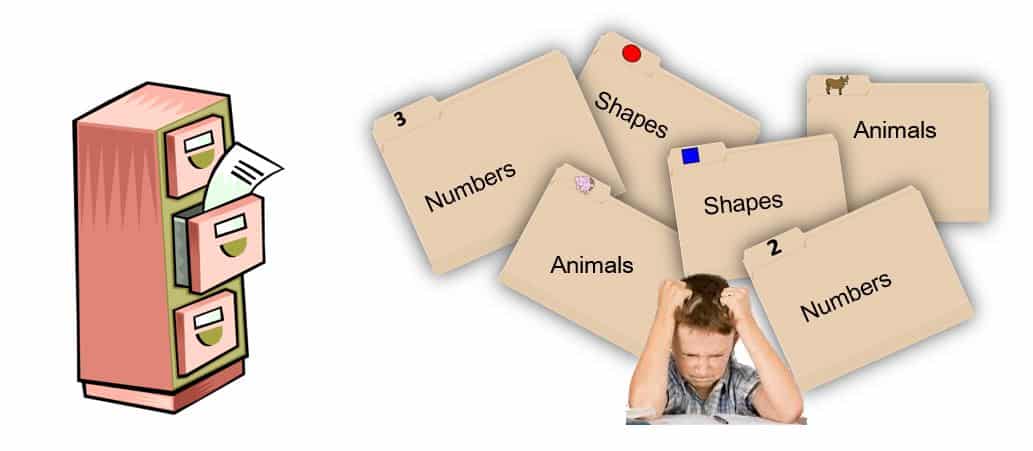 |
| Another way to consider looking at a preschool child'south brain might exist to envision it as an empty file cabinet. Each time y'all introduce a concept, the encephalon creates a new file folder. When the information is not repeated or is presented without visual cues, the result is most oft a very frustrated kid. |
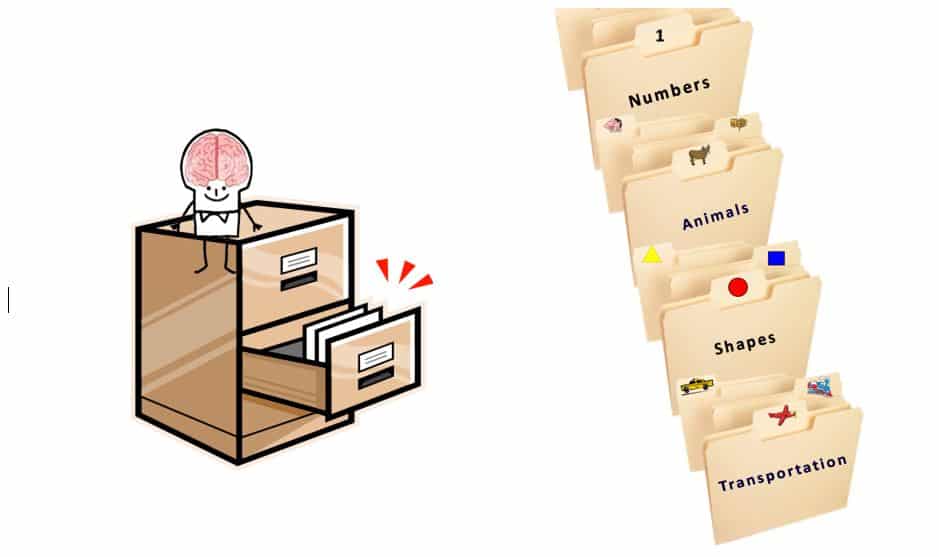 |
| Visual cues and repetition help children strengthen neural pathways. It helps them receptively classify and organize new "file binder" information and concepts. |
Many children with linguistic communication delays endure from frustration and feet, which interfere with their ability to learn. Repetition fosters predictability. The ability to predict words and phrases relieves anxiety for young children and fosters an "I tin do" attitude. Repeating a story for an extended period of fourth dimension creates a anticipated and familiar environment for learning. The length of time the story is repeated depends on the historic period and ability of the child; the younger the child, the longer the elapsing. There are 3 typical stages of language development every bit the story is repeated. In the kickoff two weeks (stage ane), children learn to process language skills receptively as the story is repeated every day (creating and strengthening neural pathways in the brain). Effectually the third week (stage two), receptive language processing results in the ability to experiment with expressive language skills. Here is where we often fall short. Once the child starts to use expressive linguistic communication, we often move on to new vocabulary and concepts too quickly. That is why the quaternary week (stage 3) is and then critical. The third phase is where we allow the child opportunities to exercise foundational skills using both receptive and expressive linguistic communication from the story. Over time as the children's language skills grow and develop, they will advance through these stages at faster and faster rates.
Generalizations of abstract and cognitive skills are a claiming for children with language delays and autism. Children oft memorize words and provide correct answers in the familiar format in which they are presented. If the format is changed, we sometimes find the child cannot generalize vocabulary and concepts in a variety of situations. This is where it becomes important to weave the storybook throughout the kid's day. This involves providing activities using characters and objects found in the story to teach or reinforce foundational skills. It is most effective when oral communication-language pathologists, occupational therapists, physical therapists, classroom teachers, and parents collaborate with each other using the story equally a common theme to help children with language delays grasp abstruse concepts in a variety of unlike situations. When all education professionals share the common focus, goals and the same repetitive story, concepts are no longer taught in isolation and the child makes greater gains.
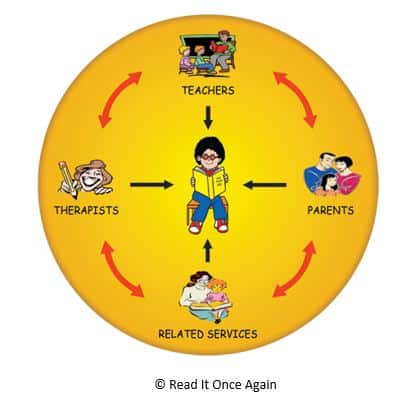 |
| When all involved use the same curriculum with one focus, the child makes greater gains. |
How do you go about providing activities that incorporate characters and objects (visual cues) from the story to be constructive tools in teaching foundational skills? Start, place the reoccurring objects and characters constitute in the story. Let's use The Very Hungry Caterpillar by Eric Carle as an example. Create a set of visual cues (pictures/graphics). These would include: leaf, caterpillar, apple, pear, plum, strawberry, orangish, block, water ice cream cone, pickle, cheese, sausage, lollipop, ruby pie, salami, muffin, watermelon, butterfly, and cocoon. For infants and toddlers, you would want to accumulate and use existent or plastic objects. Now identify the foundational skills that need to be addressed. These are typically objectives that are plant on the kid's IEP or educational plan. They may include skills such as:
- Increment the number of spoken or signed words in his/her vocabulary.
- Relate experiences with some agreement of sequence, beginning, and closure.
- Demonstrate an understanding of positional concepts.
- Place objects that are the aforementioned and different.
- Utilise the plurals of common words by adding an "s."
- Apply visual discrimination to identify big and piffling objects.
- Respond who, what, where, why, and how questions about the story.
This concept of teaching foundational skills using the graphics and characters from the story can be used with any storybook. The foundational skills can be consistently repeated and reviewed only changing the graphics when you introduce a new story. In this way, you tin can build the expressive vocabulary by changing the graphics, merely the delivery arrangement of teaching foundational skills remains the same. This helps to eliminate feet for children with auditory processing issues besides as those with language delays.
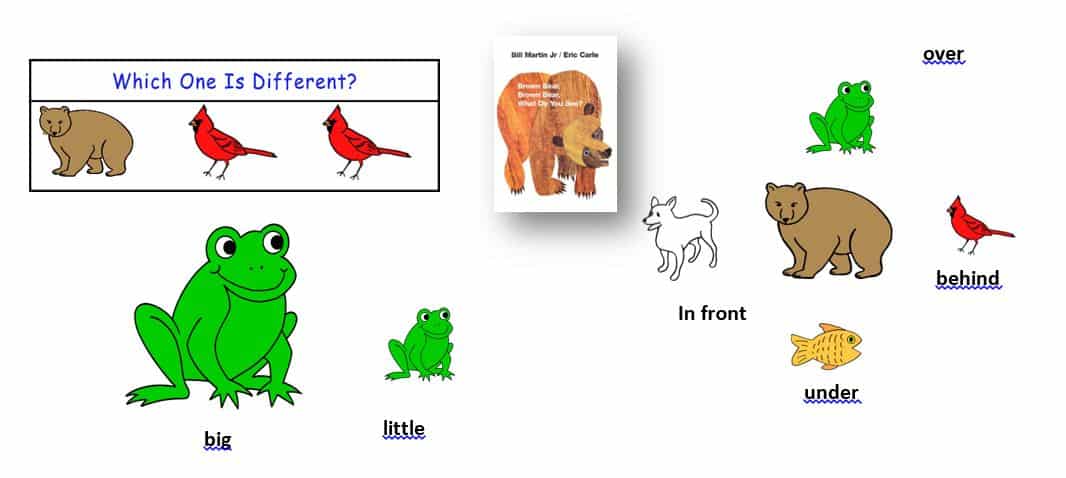 |
| Use story graphics from Brown Bear, Brown Behave, What Do Yous See? by Eric Carle to master the same foundational skills. |
Every time y'all alter the story, you have the opportunity to add new foundational skills along with repeating goals covered in previous stories. Children with language delays frequently demand the aforementioned foundational skills repeated in many different stories.
Some other essential component, in addition to repetition of storybooks, is the repeating of rhymes, and especially Mother Goose rhymes. Children with language delays and autism often struggle with expressive language. Mother Goose rhymes normally consist of unproblematic, rhythmic, rhyming text and are ofttimes set to music. The words are easily memorized and generally have fiddling logical significant. Mother Goose allows children to play with sounds and words without the stress of having to utilize the correct pronunciation or sentence structure. Many children who are on the verge of acquiring expressive language are more than probable to experiment with the rhyming nonsense words, which leads to an increase of expressive language.
Unfortunately, we see more and more young children inbound our school systems who are lacking basic foundational skills. There is an accelerated accent on academic accomplishment in kindergarten with no time for teachers to ensure that students take acquired the preschool foundational skills. What does high schoolhouse graduation have to do with preschool? Everything! When there are holes and gaps at this basic level of learning, the child will struggle all through his/her educational career. Children may lose conviction in their ability to acquire.
Speech-language pathologists often enter the flick at the preschool or kindergarten level and have the gold opportunity to help children learn the necessary foundational skills and the love of literature. Using the strategies of literature combined with repetition is an constructive method of ensuring that children will have the receptive and expressive language skills, as well equally the confidence necessary to exist successful in kindergarten and the years beyond.
Following are the xx Foundational Skills that Read It Once Once more has identified that are necessary for early learning success.
| 20 Foundational Speech and Linguistic communication Skills Necessary for Early Learning Success Based on Read It Once Over again Level 1 Curriculum Units | |
|  |
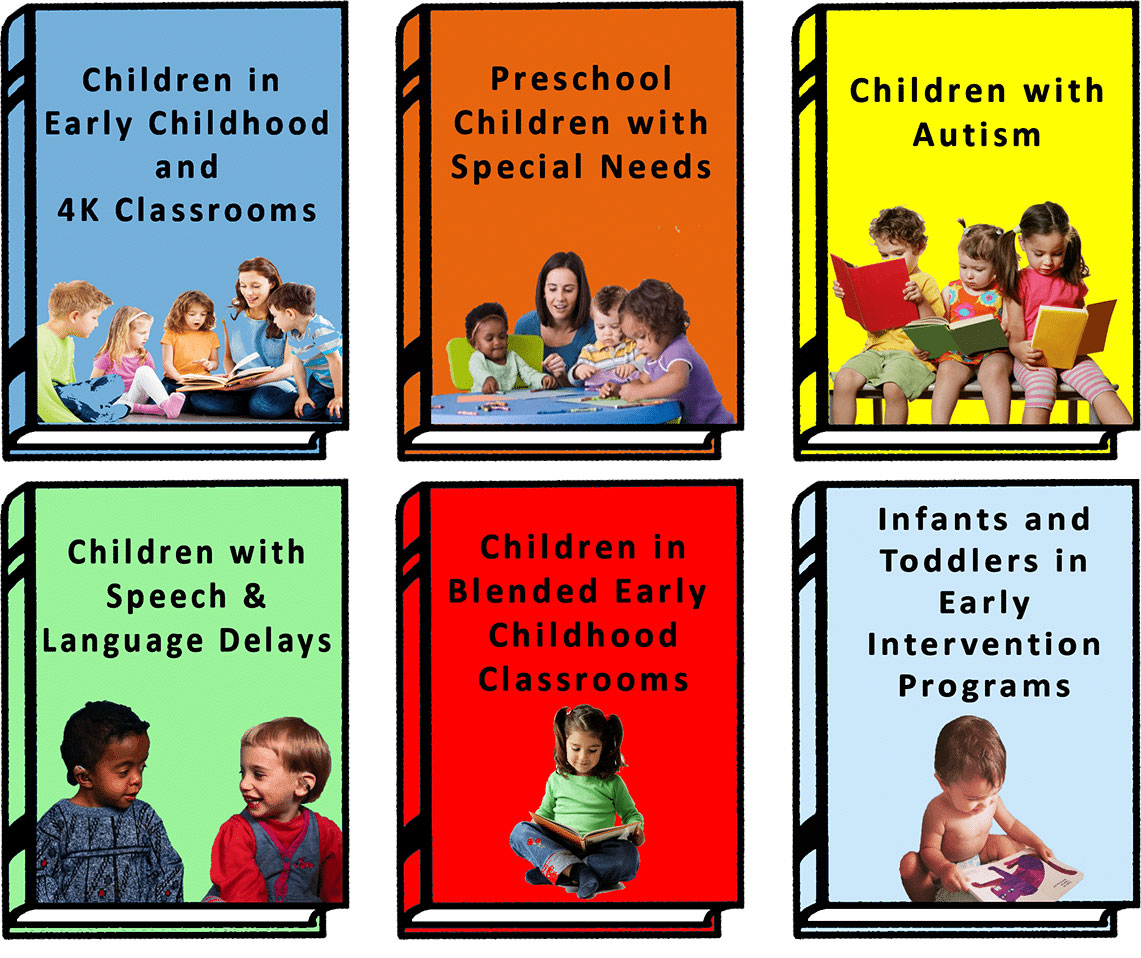 |
| To learn more about their curriculum, (click on the books on their website) that best describes how you work with young children. |
Click here for more information.
Share This, Choose Your Platform!
thompsonscame1964.blogspot.com
Source: https://www.closingthegap.com/read-it-once-again/
0 Response to "Read It Once Again Preschool Curriculum"
Postar um comentário